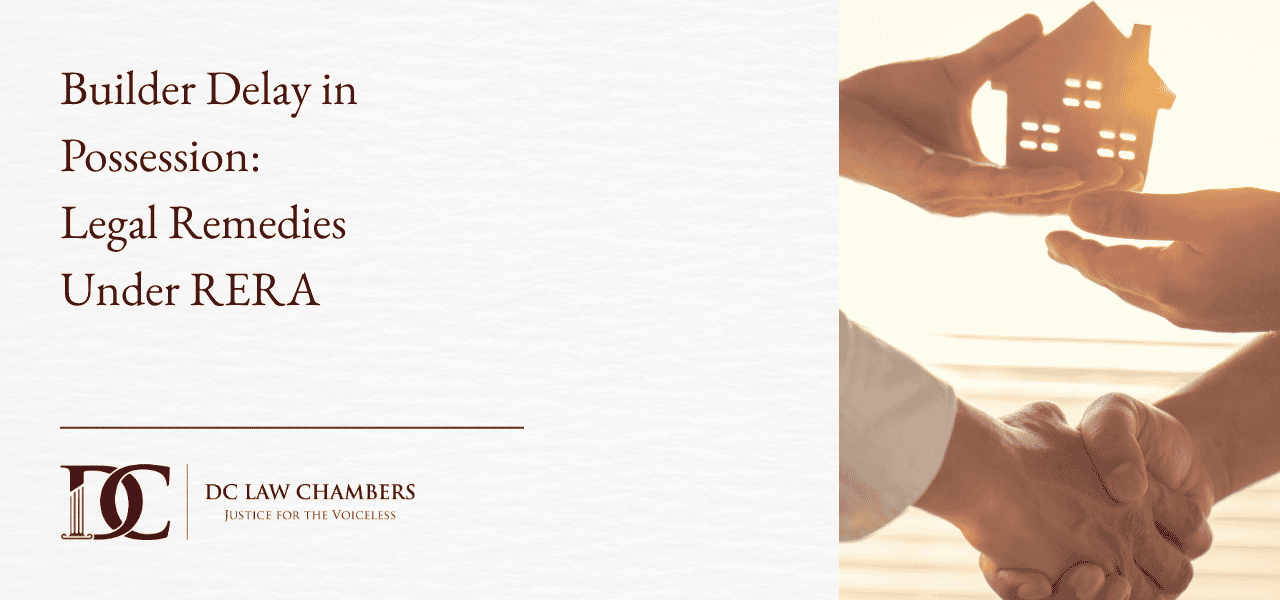
Buying a home is one of the biggest financial decisions most people make. For many families, it represents years of savings, home loan commitments, and the hope of finally owning a place to call their own. So, when a builder fails to hand over possession on time, the consequences can be both financial and emotional.
Delayed possession has long been one of the most common complaints in India’s real estate sector. Homebuyers often find themselves paying EMIs on a property they cannot occupy while continuing to bear the cost of rent. Before the introduction of the Real Estate (Regulation and Development) Act, 2016 (RERA), buyers had limited options and lengthy legal proceedings were common. RERA changed that by introducing greater accountability, transparency, and a dedicated mechanism for resolving disputes.
This article explains what constitutes a delay in possession, the legal remedies available under RERA, and the steps homebuyers can take to protect their interests.
What Does “Delay in Possession” Mean?
A builder is expected to hand over possession of a property within the timeline promised in the Builder Buyer Agreement or as registered with the relevant State RERA authority. If possession is not delivered by the agreed date without a legally valid reason, it may amount to delayed possession.
While certain circumstances, such as force majeure events, may justify an extension, routine construction delays, financial issues, or poor project management generally do not excuse the developer from its obligations.
The date mentioned in the agreement and the project’s RERA registration details often become the starting point for determining whether there has been a breach.
How RERA Protects Homebuyers
RERA was enacted to regulate the real estate sector and create a fair balance between builders and buyers. Every registered real estate project must comply with strict disclosure requirements, maintain financial discipline, and adhere to the promised timelines.
When a builder delays possession without lawful justification, the Act provides buyers with several remedies, including compensation, interest, refunds, and the right to approach the appropriate authority for relief.
The law also requires developers to keep buyers informed about project progress, approvals, and completion status, reducing the uncertainty that once surrounded under-construction projects.
Legal Remedies Available Under RERA
Depending on the circumstances, a homebuyer may pursue one or more of the following remedies.
1. Claim Interest for Delayed Possession
Under Section 18 of RERA, if the builder fails to deliver possession within the agreed timeline, the buyer is generally entitled to receive interest for every month of delay until possession is handed over.
The applicable rate of interest is prescribed by the respective State RERA Rules and is typically linked to the State Bank of India’s highest Marginal Cost of Lending Rate (MCLR), along with an additional percentage specified by the State.
This provision recognises that buyers often continue paying home loan EMIs and other expenses because of the builder’s delay.
2. Seek a Full Refund
Not every buyer wishes to wait indefinitely.
If the delay is substantial or the buyer no longer wants to continue with the project, Section 18 also allows the buyer to seek a refund of the amount paid, along with applicable interest.
This option is particularly relevant where construction has stalled, statutory approvals are missing, or there is little certainty regarding project completion.
3. Claim Compensation
In appropriate cases, buyers may also seek compensation for losses caused by the builder’s actions.
For example, a buyer may have suffered financial loss due to misleading representations, additional rental expenses, or other consequences directly linked to the developer’s failure to fulfil contractual obligations.
The nature and amount of compensation depend on the facts of each case and the evidence produced before the authority.
4. File a Complaint Before the RERA Authority
One of RERA’s most significant features is its dedicated dispute resolution mechanism.
A homebuyer can file a complaint before the State RERA Authority seeking relief against the developer. If the dispute specifically relates to compensation, it may also be heard by the Adjudicating Officer appointed under the Act.
Compared to ordinary civil litigation, RERA proceedings are intended to provide a more specialised and efficient forum for resolving disputes arising from registered real estate projects.
5. Appeal Before the RERA Appellate Tribunal
If either party is dissatisfied with the decision of the RERA Authority, an appeal may be filed before the Real Estate Appellate Tribunal within the prescribed period.
Further appeals on questions of law may lie before the jurisdictional High Court, depending on the circumstances of the case.
Can Homebuyers Approach Other Forums?
Yes.
Although RERA provides a dedicated mechanism for real estate disputes, it does not completely take away other legal remedies available to homebuyers.
The Supreme Court has clarified that the remedies available under RERA are in addition to those under the Consumer Protection Act. This means that, depending on the facts, a buyer may also approach the appropriate Consumer Commission for relief.
However, choosing the most suitable legal forum depends on the nature of the dispute, the relief sought, and the procedural considerations involved. Taking legal advice at an early stage can help buyers avoid unnecessary delays.
Important Judicial Decisions
Indian courts have consistently recognised the rights of homebuyers facing prolonged delays.
M. Imperia Structures Ltd. v. Anil Patni (2020)
The Supreme Court held that remedies under RERA do not bar proceedings under the Consumer Protection Act. Homebuyers may pursue consumer remedies where appropriate, even if RERA is available.
Pioneer Urban Land and Infrastructure Ltd. v. Govindan Raghavan (2019)
The Supreme Court observed that homebuyers cannot be compelled to accept one-sided contractual terms drafted solely in favour of the builder. The Court recognised that unfair contractual clauses deserve close judicial scrutiny.
Kolkata West International City Pvt. Ltd. v. Devasis Rudra (2019)
The Supreme Court held that a buyer cannot be expected to wait indefinitely for possession. Where there is an unreasonable delay, the buyer may seek a refund with appropriate compensation instead of continuing with the project.
These decisions have strengthened consumer rights and reinforced the principle that developers must honour their commitments.
Practical Steps Homebuyers Should Take
If possession of your property has been delayed, consider taking the following steps:
- Review the Builder Buyer Agreement and confirm the promised possession date.
- Check the project’s registration and progress updates on the relevant State RERA portal.
- Preserve payment receipts, correspondence, notices, brochures, and other project documents.
- Send a formal legal notice to the builder where appropriate.
- Seek legal advice before initiating proceedings under RERA or any other available forum.
Acting promptly can make it easier to preserve evidence and pursue appropriate legal remedies.
Conclusion
Builder delays continue to affect thousands of homebuyers across India. While construction timelines may sometimes shift because of genuine reasons, prolonged and unexplained delays can place an unfair financial burden on buyers who have honoured their commitments.
RERA has significantly improved the legal framework by giving homebuyers access to refunds, interest, compensation, and a specialised dispute resolution mechanism. Combined with the protections available under consumer law and the guidance provided by the Supreme Court, buyers today have stronger legal safeguards than ever before.
If you are facing an unreasonable delay in possession, obtaining timely legal advice can help you understand your rights, evaluate the remedies available, and take appropriate action to protect your investment.