Losing a job can be unsettling. It becomes even more difficult when an employee feels the termination was unfair or carried out without following the law. While employers have the right to end an employment relationship under certain circumstances, that right is subject to legal limits. Indian labour laws, employment contracts, and judicial decisions all recognise that employees are entitled to fair treatment and due process.
Wrongful termination is not simply about losing employment. It is about whether the employer followed the law while making that decision. Understanding the legal framework can help employees protect their rights and assist employers in maintaining fair workplace practices.
Understanding Wrongful Termination
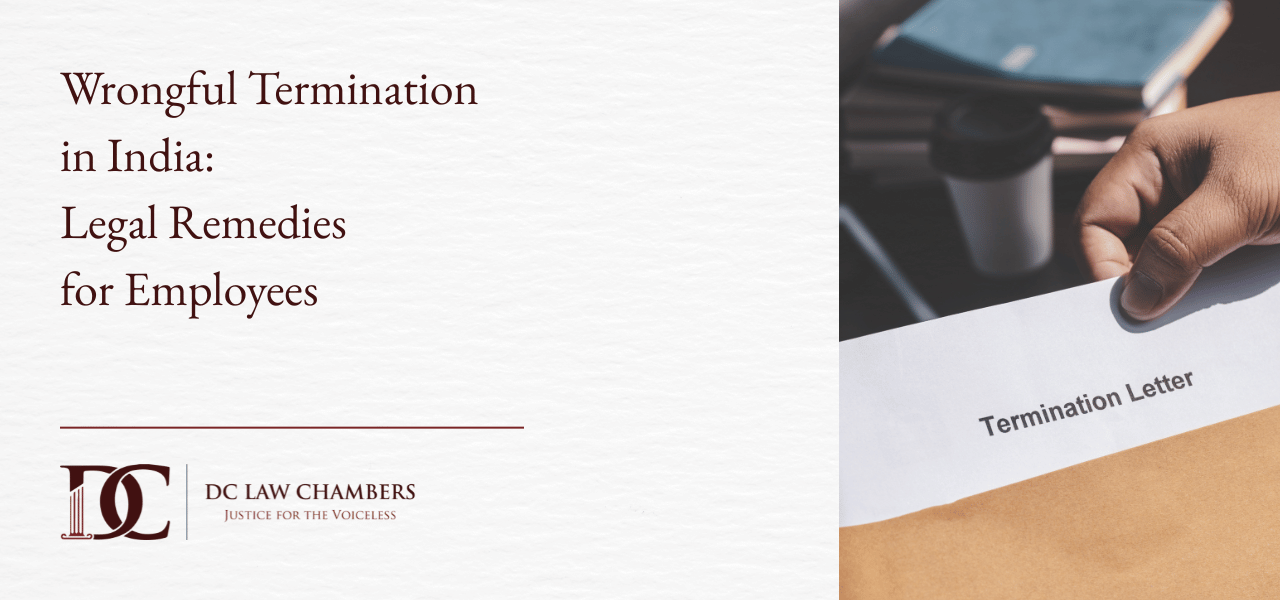
Wrongful termination refers to the unlawful dismissal of an employee in breach of labour laws, contractual obligations, company policies, or the principles of natural justice. An employer may terminate an employee for reasons such as misconduct, poor performance, redundancy, or business restructuring. However, the process followed is often just as important as the reason itself.
A dismissal may be considered unlawful if it ignores mandatory legal procedures, violates statutory protections, or disregards the terms of the employment contract.
Since employment relationships differ across industries and organisations, whether a termination is wrongful depends on the facts of each case and the laws that apply to the employee concerned.
When Can a Termination Be Considered Wrongful?
Several circumstances may give rise to a claim of wrongful termination. Some of the most common include:
- Termination without following the prescribed disciplinary procedure.
- Dismissal without giving the employee an opportunity to explain or defend themselves.
- Retrenchment without complying with statutory requirements.
- Termination in breach of the employment contract.
- Dismissal based on discrimination, victimisation, or retaliation.
- Removal for raising legitimate workplace concerns or reporting unlawful conduct.
- Termination during the exercise of statutory rights, such as maternity benefits, where legal protections apply.
Courts do not automatically treat every dismissal as illegal. Instead, they examine whether the employer acted fairly, reasonably, and in accordance with the applicable legal framework.
Legal Framework Governing Wrongful Termination
There is no single legislation that governs wrongful termination for every employee in India. The applicable law depends largely on the employee’s designation, nature of work, and the sector in which they are employed.
Industrial Disputes Act, 1947
The Industrial Disputes Act, 1947 remains one of the primary legislations protecting employees classified as “workmen.” Although the Industrial Relations Code, 2020 has been enacted to consolidate labour laws, its implementation continues to vary, making the Industrial Disputes Act relevant in many employment disputes.
The Act regulates retrenchment, layoffs, closures, and termination. Employers must satisfy specific legal requirements before retrenching eligible employees, including providing notice, compensation, and compliance with statutory procedures.
Industrial Employment (Standing Orders) Act, 1946
The Industrial Employment (Standing Orders) Act, 1946 requires certain employers to clearly define service conditions, disciplinary rules, and grounds for termination. Employees covered under certified standing orders are entitled to disciplinary proceedings that follow those prescribed procedures.
State Shops and Establishments Acts
Many employees working in commercial establishments are protected by the respective State Shops and Establishments Acts, which regulate matters such as notice periods, termination procedures, and employee benefits.
Employment Contracts
For managerial and supervisory employees who may fall outside the definition of a workman, the employment contract assumes greater significance. Courts generally examine whether the employer complied with contractual obligations relating to notice periods, severance payments, and termination clauses.
Why Natural Justice Matters
One of the defining features of Indian employment law is the importance placed on the principles of natural justice. These principles ensure that an employee is treated fairly before any serious disciplinary action is taken.
A fair process generally involves:
- Informing the employee of the allegations.
- Providing adequate time to respond.
- Conducting an impartial enquiry where required.
- Allowing the employee to present evidence and explain their position.
- Passing a reasoned decision based on the available material.
Failure to follow these safeguards may render a termination legally unsustainable, even where allegations of misconduct exist.
Domestic Enquiries and Fair Procedure
When an employer proposes to terminate an employee for misconduct, a domestic enquiry often becomes an essential part of the disciplinary process.
A domestic enquiry is an internal proceeding conducted to determine whether the allegations against an employee are substantiated. The enquiry must be impartial, transparent, and conducted in accordance with applicable service rules or standing orders.
An enquiry that is biased, incomplete, or conducted merely as a formality may not withstand judicial scrutiny. Labour Courts have consistently emphasised that procedural fairness is fundamental to disciplinary proceedings.
Judicial Approach to Wrongful Termination
Indian courts have repeatedly reinforced the importance of fairness in employment decisions.
In Workmen of Motipur Sugar Factory (P) Ltd. v. Motipur Sugar Factory (1965), the Supreme Court highlighted the necessity of conducting a proper domestic enquiry before imposing disciplinary penalties.
Similarly, in Delhi Cloth and General Mills Co. Ltd. v. Ludh Budh Singh (1972), the Court reaffirmed that disciplinary proceedings must comply with the principles of natural justice.
More recently, in Deepali Gundu Surwase v. Kranti Junior Adhyapak Mahavidyalaya (2013), the Supreme Court observed that where termination is found to be illegal, reinstatement with continuity of service and back wages may be justified depending on the facts of the case.
These decisions underline an important principle. Employers are expected not only to have valid reasons for dismissal but also to follow a fair and lawful process before arriving at that decision.
Legal Remedies Available to Employees
Employees who believe they have been wrongfully terminated may pursue different legal remedies depending on their employment status and the applicable law.
Raising an Industrial Dispute
Employees who qualify as workmen may approach the Labour Commissioner or raise an industrial dispute before the Labour Court or Industrial Tribunal seeking appropriate relief against unlawful termination.
Civil Remedies
Managerial and senior employees governed primarily by contractual terms may initiate civil proceedings for breach of contract, particularly where the employer has failed to honour notice obligations or other contractual commitments.
Constitutional Remedies
Employees working in public employment or government-controlled bodies may, in appropriate cases, seek relief before the High Court under Article 226 of the Constitution of India where constitutional or statutory rights have been violated.
Statutory Remedies
Depending on the facts, employees may also rely on protections available under labour legislation, State Shops and Establishments Acts, maternity benefit laws, and other applicable statutes.
Relief That Courts May Grant
The relief available depends on the facts of each case and the forum hearing the dispute.
Courts and tribunals may grant:
- Reinstatement in service.
- Back wages.
- Continuity of service.
- Compensation instead of reinstatement.
- Payment of unpaid salary, gratuity, leave encashment, or other statutory dues.
- Notice pay and contractual benefits.
- Any other relief considered appropriate under the circumstances.
In recent years, courts have increasingly considered whether reinstatement is practical. Where restoring the employment relationship is no longer feasible, monetary compensation may be awarded instead.
Practical Steps Following a Wrongful Termination
Employees who believe they have been dismissed unlawfully should take prompt and informed action.
Some practical steps include:
- Preserve the termination letter and employment contract.
- Collect salary slips, emails, performance reviews, and other employment records.
- Retain copies of disciplinary notices or enquiry proceedings, if any.
- Carefully review any settlement agreement before signing it.
- Seek legal advice to understand the remedies available and the applicable limitation periods.
Maintaining complete documentation often plays a decisive role in employment disputes.
Conclusion
Wrongful termination remains one of the most significant areas of employment law in India because it directly affects an individual’s livelihood and professional reputation. While employers have the authority to make business decisions relating to their workforce, that authority must be exercised within the framework of the law. Compliance with statutory obligations, contractual terms, and the principles of natural justice is not merely a procedural requirement. It is an essential safeguard against arbitrary dismissal.
For employees, understanding these legal protections can provide clarity during an otherwise uncertain situation. For employers, adopting fair and transparent termination practices helps minimise disputes and promotes greater trust within the workplace.