
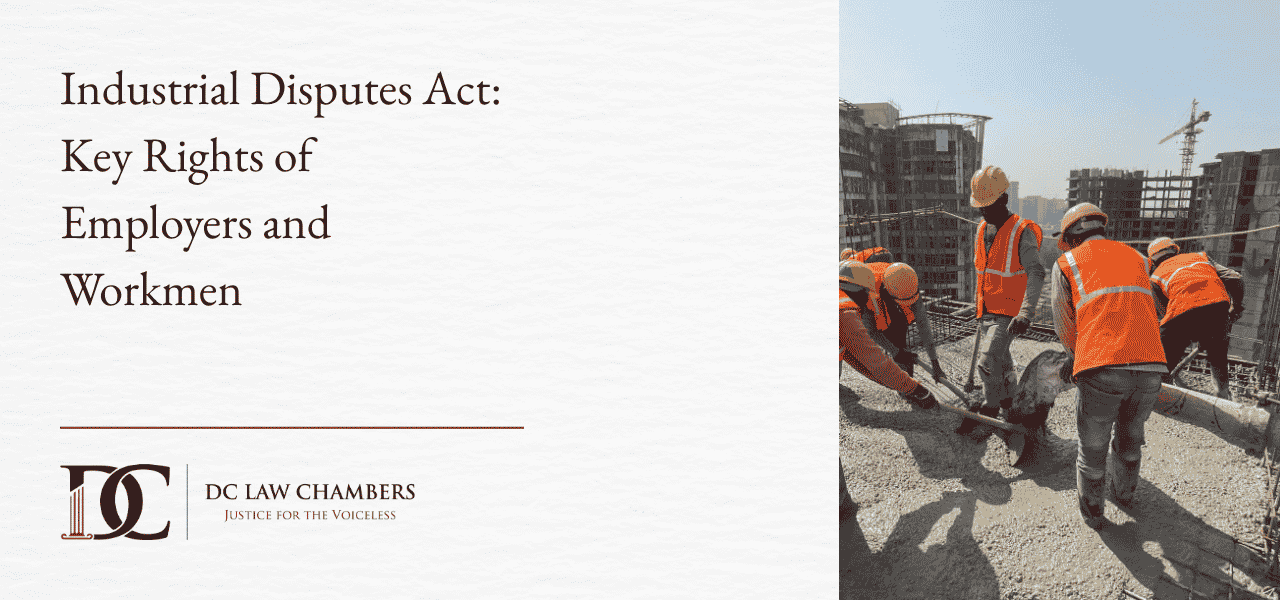
The relationship between employers and workmen has always required a careful balance. Every business needs the freedom to make commercial decisions, maintain discipline, and respond to changing market conditions. At the same time, employees are entitled to fair treatment, job security, and protection against arbitrary actions. Labour laws exist to ensure that one interest is not pursued at the expense of the other.
For more than seven decades, the Industrial Disputes Act, 1947 has served as one of the cornerstones of India’s labour law framework. It established a structured mechanism for resolving industrial disputes, regulating layoffs, retrenchment, strikes, lockouts, and closures, while encouraging dialogue between employers and workmen before conflicts escalated into prolonged litigation.
Although the Industrial Relations Code, 2020 seeks to replace the Industrial Disputes Act by consolidating it with other labour legislations, the legal principles developed under the Act continue to shape industrial relations in India. Until the Code is fully implemented across all jurisdictions, and even thereafter through judicial interpretation, the Industrial Disputes Act remains highly relevant for businesses, employers, HR professionals, and workmen alike.
The Objective Behind the Industrial Disputes Act
The Industrial Disputes Act was enacted with a simple yet significant purpose: to promote industrial harmony. It recognises that disagreements in the workplace are inevitable, whether they arise from disciplinary action, wage disputes, retrenchment, transfers, or changes in service conditions. The law therefore focuses not only on resolving disputes but also on preventing them from disrupting industrial peace.
Rather than encouraging immediate litigation, the Act provides a structured framework that prioritises conciliation, negotiation, and settlement. Labour Courts and Industrial Tribunals become the next step only when these efforts fail. This approach reflects a broader policy objective that productive employer-employee relationships are ultimately beneficial for businesses, workers, and the economy as a whole.
The Rights of Employers Under the Industrial Disputes Act
The Industrial Disputes Act is often perceived as legislation primarily intended to safeguard employees. While employee protection is undoubtedly one of its central objectives, the Act also recognises that employers must retain sufficient authority to manage their organisations effectively. Running a business inevitably involves commercial decisions, operational restructuring, workforce management, and disciplinary action. The law does not prevent these decisions from being made. Instead, it ensures that they are exercised within a fair and transparent legal framework.
An employer continues to have the right to organise business operations, allocate work, introduce new technologies, restructure departments, and implement workplace policies that support efficiency and productivity. Indian courts have consistently acknowledged that managerial decisions should ordinarily remain within the employer’s discretion unless they violate statutory safeguards or principles of fairness.
Disciplinary proceedings provide another important example. Allegations of misconduct, habitual absenteeism, fraud, insubordination, or negligence may justify disciplinary action. However, the legitimacy of such action often depends less on the allegation itself and more on whether the employer followed due process. The principles of natural justice require that the concerned workman be informed of the allegations, given a reasonable opportunity to respond, and heard through a fair domestic enquiry before any major penalty is imposed.
The Supreme Court’s decision in Workmen of Firestone Tyre & Rubber Co. of India (P) Ltd. v. Management remains one of the leading authorities in this regard. The Court recognised the employer’s right to conduct disciplinary proceedings while making it equally clear that procedural fairness cannot be ignored. A properly conducted enquiry frequently determines whether disciplinary action will withstand judicial scrutiny.
The Act also permits employers to retrench employees or declare layoffs and lockouts under specific circumstances. These are legitimate business tools, particularly where organisations face financial distress, technological changes, or declining demand. However, the exercise of these rights is subject to statutory safeguards, including notice requirements, payment of compensation, and compliance with prescribed procedures. Failure to observe these requirements may render the employer’s action legally unsustainable, regardless of the underlying business justification.
Protecting the Rights of Workmen
While employers possess managerial authority, the Industrial Disputes Act acknowledges that employment relationships often involve unequal bargaining power. For this reason, the legislation provides several safeguards designed to protect workmen against arbitrary or unfair treatment.
Perhaps the most significant protection relates to termination of service. Employers cannot simply discontinue the employment of an eligible workman without following the procedure established by law. Depending upon the circumstances, notice periods, retrenchment compensation, and compliance with the “last come, first go” principle become essential considerations. These procedural safeguards are intended to ensure that employment decisions are neither arbitrary nor discriminatory.
The judiciary has repeatedly reinforced this principle. In Harjinder Singh v. Punjab State Warehousing Corporation, the Supreme Court emphasised that labour legislation is welfare-oriented and should be interpreted in a manner that advances its protective purpose while remaining consistent with statutory provisions. The judgment reaffirmed that procedural fairness remains central to employment decisions affecting workmen.
Beyond protection against wrongful termination, the Act also empowers workmen to challenge unfair service conditions, disciplinary action, unlawful retrenchment, and disputes relating to wages or other employment benefits. Where internal discussions fail to resolve the issue, the law provides access to conciliation proceedings, Labour Courts, and Industrial Tribunals. This structured mechanism enables disputes to be examined by specialised forums familiar with industrial relations rather than through ordinary civil litigation.
The right to collective bargaining also occupies an important place within the industrial dispute resolution framework. Trade unions have historically played a significant role in representing the interests of workmen during negotiations concerning wages, working conditions, and service benefits. The Act encourages negotiated settlements because mutually agreed solutions often preserve workplace relationships far better than adversarial legal proceedings.
The right to strike is another recognised aspect of industrial relations, although it is not absolute. The Act regulates strikes through procedural requirements intended to balance the interests of employees with the continuity of business operations and public welfare. Particularly in public utility services, statutory notice requirements become critical. Courts have consistently held that while collective action may be legitimate, it must remain within the boundaries prescribed by law.
Resolving Industrial Disputes Through Institutional Mechanisms
One of the enduring strengths of the Industrial Disputes Act lies in its emphasis on institutional dispute resolution. Instead of encouraging parties to immediately approach the courts, the legislation seeks to resolve disagreements at the earliest possible stage through conciliation and negotiation.
Conciliation Officers frequently serve as the first point of intervention, facilitating discussions between employers and workmen in an effort to arrive at an amicable settlement. Where conciliation fails, disputes may be referred to Labour Courts or Industrial Tribunals depending on their nature. Arbitration also remains available where both parties voluntarily agree to adopt that route.
This layered approach reflects an important legislative philosophy. Industrial disputes rarely benefit from prolonged confrontation. Timely intervention often protects business continuity while preserving employment relationships that might otherwise deteriorate beyond repair.
The Transition to the Industrial Relations Code, 2020
India’s labour law reforms have introduced the Industrial Relations Code, 2020, which consolidates the Industrial Disputes Act, the Trade Unions Act, and the Industrial Employment (Standing Orders) Act into a single legislative framework. The objective is to simplify labour law compliance while retaining many of the established principles that have developed through decades of judicial interpretation.
Several aspects of the Code differ from the earlier framework, including revised thresholds for obtaining prior government approval in cases of retrenchment, layoff, and closure, formal recognition of negotiating unions, and updated provisions governing strikes and lockouts. At the same time, the fundamental objective remains unchanged: maintaining a balance between managerial autonomy and employee protection.
Since the implementation of the Code depends upon notifications issued by the Central and State Governments, organisations should remain mindful of the legal framework currently applicable to their operations. Businesses that continue to rely solely on past practices without reviewing recent legislative developments may expose themselves to unnecessary legal risks.
Conclusion
The Industrial Disputes Act has shaped labour relations in India for generations by recognising that sustainable industrial growth depends upon fairness, accountability, and effective dispute resolution. Its provisions neither favour employers unconditionally nor grant unrestricted rights to workmen. Instead, the legislation seeks to balance legitimate business interests with the need to protect employees against arbitrary treatment.
Even as the Industrial Relations Code, 2020 gradually replaces the earlier regime, the principles established under the Industrial Disputes Act continue to guide employers, workmen, and courts alike. Businesses that understand these principles are better equipped to make informed employment decisions, while workmen remain aware of the protections available to them under law. Ultimately, compliance is not merely about avoiding disputes. It is about building workplaces founded on trust, transparency, and respect for legal rights.