When consumers pay for a service, they expect it to be delivered with reasonable care, within the agreed timeline, and in accordance with the promises made. Most businesses strive to meet these expectations, but disputes arise when the service provided falls significantly below the required standard. A delayed housing project, an insurer refusing a valid claim without justification, or a bank mishandling a customer’s account can leave consumers facing financial loss and unnecessary hardship.
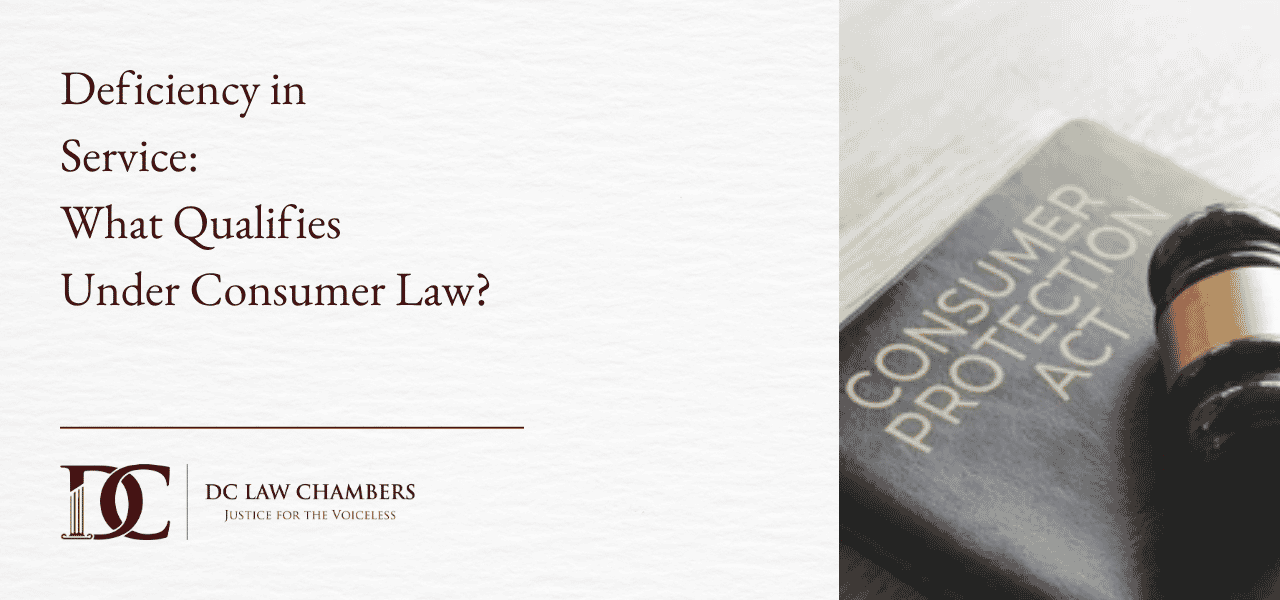
The Consumer Protection Act, 2019 was enacted to safeguard consumers against unfair practices and provide an accessible mechanism for resolving disputes. One of the most frequently invoked grounds under the Act is deficiency in service. While the phrase appears straightforward, whether a particular act or omission amounts to a legal deficiency depends on the facts of each case, the contractual obligations between the parties, and the standard of care expected from the service provider.
Understanding what the law recognises as a deficiency in service is valuable not only for consumers seeking redress but also for businesses that wish to minimise disputes and maintain fair service standards.
Understanding the Legal Meaning of Deficiency in Service
Section 2(11) of the Consumer Protection Act, 2019 defines deficiency as any fault, imperfection, shortcoming, inadequacy, or omission in the quality, nature, or manner of performance that is required by law, has been undertaken under a contract, or is otherwise expected to be maintained in relation to a service.
In practical terms, this means a service provider may be held liable when they fail to perform their obligations with the level of care, skill, or diligence that consumers are reasonably entitled to expect. The law does not insist on perfection, nor does it penalise every inconvenience. Instead, it examines whether the service fell below an accepted legal or contractual standard and whether that failure caused loss or prejudice to the consumer.
Consumer Commissions therefore look beyond the complaint itself. They consider the terms of the agreement, the conduct of both parties, industry standards, documentary evidence, and the surrounding circumstances before determining whether a deficiency actually exists.
When Does a Service Become Deficient?
A consumer dispute does not arise merely because someone is dissatisfied with the outcome of a service. There must generally be a demonstrable failure on the part of the service provider to fulfil a legal, professional, or contractual obligation.
For instance, negligence, unreasonable delays, poor workmanship, failure to honour contractual commitments, or providing a service that does not meet the promised standard may all constitute deficiency in service. Equally important is the impact of that failure. Consumer Commissions often examine whether the deficiency resulted in financial loss, inconvenience, mental agony, or other tangible harm.
Evidence also plays a significant role. Agreements, invoices, emails, payment receipts, photographs, service records, and written communications frequently determine whether a complaint succeeds. Even a genuine grievance may become difficult to establish in the absence of supporting documents.
Industries Where Consumer Disputes Commonly Arise
Although the concept applies across almost every service sector, certain industries account for a substantial number of consumer complaints.
Banking and financial services frequently give rise to disputes involving unauthorised transactions, wrongful freezing of accounts, delays in processing payments, or negligent handling of customer instructions. Financial institutions are expected to exercise a high degree of care because consumers rely on them to safeguard their money and process transactions accurately. Where avoidable errors result in financial loss, consumer forums have often treated such lapses as deficiencies in service.
The insurance sector is another common area of litigation. Consumers often approach Consumer Commissions when genuine claims are rejected without adequate justification, settlements are delayed despite complete documentation, or policy terms are interpreted in an unfair manner. Courts have consistently observed that insurers are expected to act fairly and in good faith while evaluating claims rather than relying on technicalities to deny legitimate benefits.
In the field of healthcare, determining deficiency in service requires a careful examination of medical evidence. The law does not presume negligence simply because a treatment does not produce the desired outcome. Instead, the question is whether the medical professional exercised the reasonable degree of skill and care expected under the circumstances. Cases involving incorrect diagnosis due to negligence, failure to obtain informed consent where necessary, or inadequate post-operative care may fall within the scope of deficiency in service if supported by evidence.
The real estate and housing sector continues to generate a large number of consumer disputes. Delayed possession of residential units, failure to provide promised amenities, poor construction quality, and deviations from approved plans have repeatedly been examined by consumer forums. The Supreme Court and the National Consumer Disputes Redressal Commission have, in several decisions, recognised that prolonged and unjustified delays by builders can amount to deficiency in service, particularly where homebuyers continue to bear financial burdens without receiving possession of their property.
Consumer complaints have also increased significantly in the digital economy. Online marketplaces, travel portals, payment platforms, and other e-commerce service providers are expected to fulfil their obligations with the same degree of accountability as traditional businesses. Failure to deliver paid services, unjustified cancellation of confirmed bookings, unreasonable delays in processing refunds, or misleading representations about services offered online may all invite scrutiny under the Consumer Protection Act, 2019 and the Consumer Protection (E-Commerce) Rules, 2020.
What Does Not Amount to Deficiency in Service?
The existence of a consumer complaint does not automatically establish legal liability. There are many situations where dissatisfaction alone is insufficient to constitute a deficiency in service.
If a service provider performs its obligations in accordance with the contract and applicable law, liability may not arise simply because the consumer expected a different outcome. Similarly, delays caused by circumstances genuinely beyond the provider’s control, such as regulatory restrictions or unforeseen events, may not always amount to deficiency if reasonable steps were taken to minimise the impact.
Consumer Commissions also consider the conduct of the consumer. Where a complaint arises because the consumer failed to comply with contractual requirements, withheld necessary information, or did not fulfil their own obligations, the claim may not succeed. Ultimately, each dispute is assessed on its individual facts rather than through broad assumptions.
Remedies Available Under the Consumer Protection Act
Where deficiency in service is established, Consumer Commissions have the authority to grant relief that is appropriate to the circumstances of the case. Depending on the nature of the dispute, this may include directing the service provider to compensate the consumer for financial loss or mental agony, refund the amount paid, rectify the deficiency, or discontinue unfair practices.
The Consumer Protection Act, 2019 provides a structured dispute resolution mechanism through the District, State, and National Consumer Disputes Redressal Commissions, enabling consumers to pursue remedies without necessarily resorting to prolonged civil litigation. At the same time, parties are increasingly exploring mediation under the Act as an efficient means of resolving disputes where an amicable settlement is possible.
Why Documentation Can Make or Break a Consumer Claim
One of the most overlooked aspects of consumer litigation is documentation. Regardless of how compelling a grievance may appear, its success often depends on the evidence available. Consumers should preserve invoices, contracts, payment receipts, emails, messages, photographs, and records of communication with the service provider. These documents not only establish the terms of the transaction but also help demonstrate whether the service provider failed to meet the required standard.
Businesses, too, benefit from maintaining clear records. Transparent communication, written acknowledgements, and timely responses to customer concerns often play an important role in resolving disputes before they escalate into litigation.
Conclusion
The law relating to deficiency in service is ultimately built on a simple principle: when consumers pay for a service, they are entitled to receive what has been promised with reasonable care, competence, and fairness. The Consumer Protection Act, 2019 seeks to uphold this principle by providing an effective legal framework for addressing genuine service failures while ensuring that businesses are not held liable for every inconvenience or unsuccessful outcome.
For consumers, recognising the difference between ordinary dissatisfaction and a legally actionable deficiency is the first step towards asserting their rights. For service providers, maintaining transparency, honouring contractual commitments, and responding promptly to grievances remain the most effective ways to reduce disputes and build trust. As consumer expectations continue to evolve across both traditional and digital services, the importance of delivering consistent and accountable service has never been greater.